New Member Guide
You've joined a faction that treats warfare as engineering and payouts as math — not politics. We innovate. We optimize. We win, and when we can't win, we make the other side pay us to lose. Everything here runs on transparency and data. If the numbers say you carried, you get paid like you carried. If they say you didn't show up, that shows too.
This guide tells you what you need to do in your first week, what's expected of you, and how to get plugged into the systems that make this faction run.
NEXUS is the faction's intelligence and payout system — part wartime advisor, part accountant, part content engine. It processes war data, calculates payouts, builds targeting tools, and produces the briefings you'll see before and after every war. Every newsletter, every payout table, every target recommendation comes through NEXUS.
NEXUS is transparent by design. Every formula is published before the war starts. Every payout is calculated from data, not discretion. If something looks wrong, you're encouraged to flag it — members who've caught formula errors have been rewarded for it.
Get these done before anything else:
- Connect to YATA — Go to yata.yt, log in with your Torn API key, navigate to Faction → Members, and enable "Sharing your stats and energy with leadership." This is required. Without it, NEXUS can't build your personalized war targets, and leadership can't see your energy during wars. (Note: it's yata.yt with no "www" — the www address does not exist and will fail to load.)
- Connect to TornStats — Go to tornstats.com and link your account. This is a backup data source for stat tracking and spy data.
- Read the OC 2.0 Decision Engine — Go to the Decision Engine and figure out which tier you fall into (Recon, Core, or Carry). Then join an OC. The faster you start, the faster everybody earns.
- Check the faction armory — Loan any materials you need for your OC role before your crime is ready to begin. Zip Ties, Hand Drills, Core Drills, Shaped Charges, and Firewalk Viruses are stocked for faction use.
When a ranked war is announced, NEXUS produces a full preparation package: a threat assessment, a personalized target finder, a decision tree, and a payout formula. You'll know exactly who to hit, in what order, and what you'll earn for it.
Show up. Participation is the baseline. Every war payout formula has a participation gate — zero hits means zero payout, regardless of anything else. Beyond that, follow the target finder, follow the decision tree, and communicate when you're active.
The moment we are matched for a war, switch your revives to NOBODY. Torn → Settings → Preferences → Revives → No one. This is not optional and it is not a leadership call — it applies to every member for the entire war.
A revivable body is a farmable body. If you are revivable, the enemy hospitalizes you, revives you, and hits you again — the same member conceding respect over and over. Revivable members lose wars. If you genuinely need a revive during the war, flip it on, take it, and flip it straight back off immediately. Never leave it open.
Legitimate Business invented playing defense in ranked wars. Our doctrine is unavailability, not absorption. When you're not actively hitting, stay in the hospital. Self-hospitalize or fly out if enemies are farming you. The payout system rewards members who conceded the least respect to the opponent — not those who took the most hits.
In group fights, the member with the best Fair Fight multiplier should take the finish. The payout system counts assists and kills equally — and awards bonus actions to assisters when the finisher has high Fair Fight. Kill-stealing at low Fair Fight earns you less, not more. The incentive is aligned: let the right person finish.
Don't mug during war unless the mug is genuinely worth it — bad mugs carry a negative respect modifier that drags your score down. Don't waste bonus hits on outside targets — hit #10, #25, #50, #100, and every milestone after should always land on a war target. Don't revive early unless leadership calls a push — you're denying points by staying down.
The faction runs two crimes: Break the Bank (Level 8) and Blast From the Past (Level 7). Every other crime exists only to generate scope for these two. The OC 2.0 Decision Engine explains the role system, the CPR minimums, and exactly what you should do based on your tier.
The core philosophy: the more crimes you cycle through, the more money everybody makes. A ~70% success rate is the sweet spot. Failures are priced in — they're the cost of maximum expected value. The only real mistake is running safe crimes out of fear.
Every war payout follows a published formula. The formula is shared before the war starts so you know exactly what's being measured. After the war, NEXUS calculates the results, leadership reviews them, and then members get a feedback window to review and raise concerns before payments go out.
The current payout framework (v2.4) is fully data-driven with no discretionary pool. It weights participation, war actions (kills + assists + bonus actions), respect earned (adjusted for Fair Fight quality), and defensive contribution. The exact weights may shift between wars depending on the matchup and war type — NEXUS publishes the specific formula each time.
The moment you hit Level 15, the Travel Agency unlocks — and with it the simplest money printer in Torn: buy cheap foreign goods, sell high back home. The poster below covers the essentials — profit items, capacity boosters, and the four golden rules. Contributed by Crysi, friend of the family.
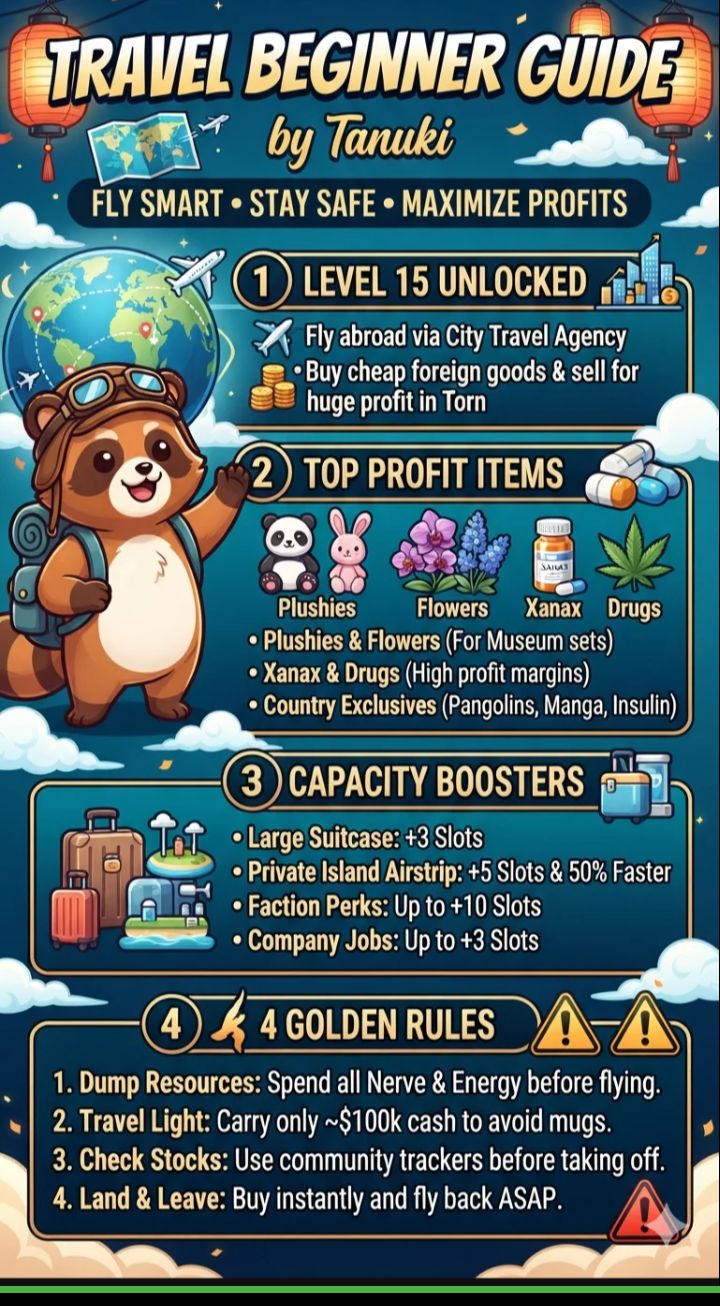
Click to open full size · Travel Beginner Guide by Tanuki
During wars, communicate who is watching and who is around — especially during dead zones. If nobody knows you're there, nobody knows the chain is safe. YATA's chain watcher metric tracks who kept the chain alive, and the payout formula rewards it.
The #nexus-interface channel is where payout feedback goes after each war. If something in the numbers doesn't look right, that's where you raise it. Constructive feedback has tangible value — it's how the system improves.